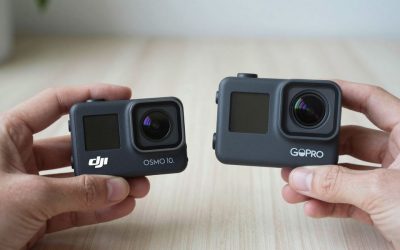
DJI Osmo Pocket and GoPro solve the “I want great footage without carrying a big camera” problem in very different ways. One is a handheld gimbal camera built for smooth, framed shots; the other is a rugged, mountable action camera built to survive situations a Pocket never should go near. Here’s how to tell which one actually fits your content, rather than just which one has the flashier spec sheet.
The easiest way to frame the decision is by asking where the camera physically lives during filming. If it’s almost always in your hand, held out in front of you or to the side while you talk, the Pocket’s gimbal and larger sensor will usually win on image quality. If it’s mounted to your body, your gear, or submerged, GoPro’s ruggedness stops being a nice-to-have and becomes the entire reason the shot is possible at all.
DJI Osmo Pocket 3
The Osmo Pocket 3 pairs a 1-inch sensor — significantly larger than what’s inside most action cameras — with a built-in 3-axis mechanical gimbal, producing noticeably smoother, higher-quality footage for handheld walking shots, interviews, and general vlogging. The flip screen rotates for vertical video, which matters enormously if your content lives on short-form platforms.
Pros: excellent image quality for its size thanks to the larger sensor, mechanically smooth gimbal stabilization, flip screen built for vertical content. Cons: not waterproof or rugged out of the box, and it’s a poor choice for mounting on a helmet or board.
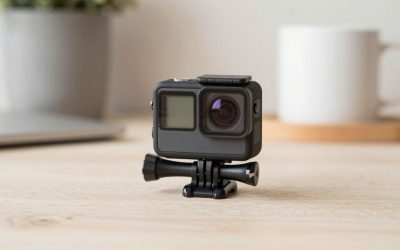
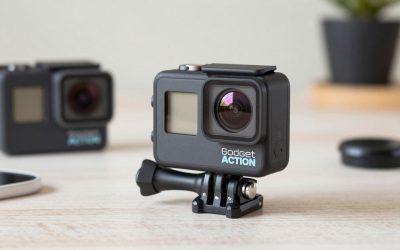
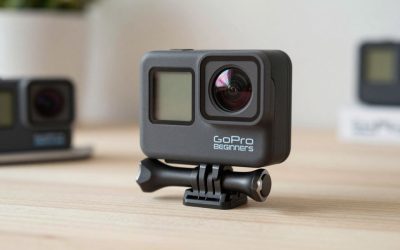
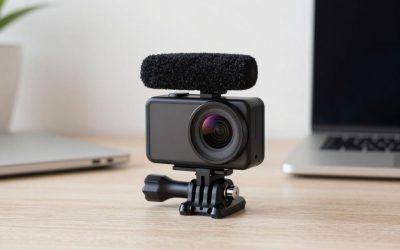
GoPro HERO13 Black
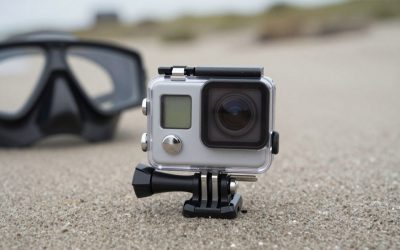
GoPro’s current flagship remains the benchmark for durability and mountability — it’s waterproof without a case, survives drops and rough handling that would damage a Pocket 3, and mounts to helmets, chest harnesses, bike handlebars, and virtually anything else thanks to GoPro’s enormous mounting ecosystem. Image quality is excellent, though the smaller sensor can’t quite match the Pocket 3’s low-light and depth-of-field look.
Pros: genuinely rugged and waterproof, massive third-party mounting accessory ecosystem, excellent stabilization for action and sports footage. Cons: handheld footage without a mount looks noticeably less cinematic than the Pocket 3’s gimbal-smoothed shots.
Insta360 X5 (360-Degree Alternative)
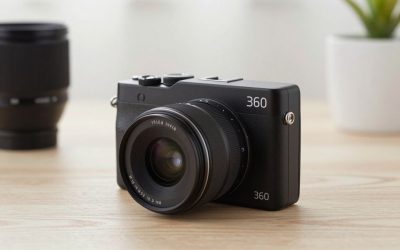
There’s a third option worth knowing about if neither a gimbal camera nor a traditional action camera quite fits: a 360-degree camera like the Insta360 X5 captures the entire scene around it at once, letting you “reframe” the shot after filming rather than committing to an angle in the moment. For action sports or fast-moving content where you can’t always predict the best angle in advance, that flexibility solves a problem neither the Pocket 3 nor GoPro can.
Pros: captures every angle at once so you never miss the shot, rugged and waterproof build, flexible reframing in editing after the fact. Cons: 360 footage requires an extra reframing step in editing that standard footage doesn’t, and file sizes run larger.
Editing workflow is the part people most often underestimate when choosing between these three. Osmo Pocket 3 footage is ready to use straight out of the camera with minimal editing. GoPro footage benefits from stabilization and color correction but is still a standard flat video file. A 360 camera like the X5 requires an extra reframing pass in its companion app before you get a normal-looking video, which adds a real step to your workflow — worth it for the creative flexibility, but not something to discover for the first time right before a deadline.
Verdict: if your vlogging is mostly talking to camera while walking, filming interviews, or general lifestyle content where image quality and smooth handheld framing matter most, the Osmo Pocket 3 produces better-looking results. If your content involves any physical activity, water, mounting on gear, or situations where a drop or splash is a real risk, GoPro’s durability and mounting flexibility make it the safer and more versatile choice — many creators who do both end up owning one of each rather than forcing one camera to cover every situation.
Budget for accessories too, since the “real” cost of either system includes more than the camera body. GoPro’s mounting ecosystem is cheap and extensive but adds up if you buy several mounts; the Osmo Pocket 3’s main extra cost is usually just a case and maybe an extension rod, since it’s less often mounted to external gear.
FAQ
Can the Osmo Pocket 3 survive being dropped or getting wet?
It’s not built for that kind of use — a hard drop or submersion is a real risk to the exposed gimbal mechanism, unlike GoPro’s sealed, ruggedized body.
Which one is better for vertical, short-form video?
The Osmo Pocket 3’s rotating flip screen is specifically designed for shooting and framing vertical video natively, which GoPro supports through cropping but doesn’t build the hardware around as directly.
Is GoPro still worth it if I never plan to mount it anywhere?
If you’ll only ever hold it by hand and never mount or submerge it, the Osmo Pocket 3’s gimbal and sensor will likely give you better-looking footage for that specific use case.
Which one has better battery life for a full day of filming?
Both require planning around battery life for a full day of heavy use, though GoPro’s larger accessory ecosystem makes carrying spare or external batteries slightly more straightforward.
Can either camera double as a regular point-and-shoot for photos?
Both take respectable still photos, but neither fully replaces a dedicated photo camera for serious stills work — they’re built primarily around video, with photo capability as a strong secondary feature.
Is a 360 camera like the Insta360 X5 harder to learn than a Pocket 3 or GoPro?
The filming itself is simple since you just mount or hold it and record, but the reframing and editing step afterward has a real learning curve compared to footage that’s ready to use straight from the camera.
Which of the three holds up best for underwater or heavy-rain filming?
GoPro and the Insta360 X5 are both rated for serious water exposure, while the Osmo Pocket 3 is the one of the three that genuinely needs a separate waterproof case before going anywhere near water.

Write Your Review
No reviews yet. Be the first to share your experience!